

Acoustic Design ResearchAcoustic Research for Studios & Listening RoomsRecording Studio & Room Acoustics ResearchAcoustic Design Research: Recording Studio & Music Room AcousticsResearch in Acoustic Design

Acoustic Diffusers: Design by Optimization
Essential in most music rooms, diffusers reduce reflections and create a pleasant reverberant sound field. This project shows how mathematical optimization was used to design efficient sound diffusers.
Thesis Question: what simple-to-make profiled wall shape (‘stepped diffuser’) gives an optimal trade-off between uniform diffusion and compact geometry? And how can this surface be discovered using a simple design framework (i.e., without boundary element methods)?
Method: A design system was rapidly prototyped, termed the “lean” optimization framework. It uses an integer genetic algorithm to find candidate designs, and grades them using a finite difference time domain scattering simulation.
The resulting diffuser designs offer an excellent trade-off between performance and simple geometry. They are simpler to manufacture than most diffusers and can be built using local labour and materials. Fractal versions of the designs offer an extended ... [Click for videos & more]
Eco Recording Studio Design
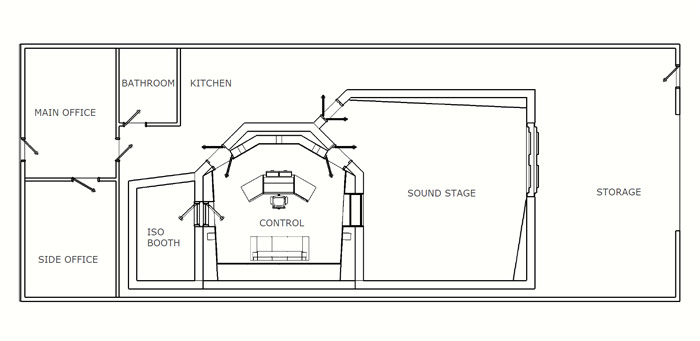
Sustainable buildings struggle with acoustic control. Can we design an eco music studio that achieves both acoustical and green goals?
Part I presents the acoustics and a building-integrated solar power system for the conceptual recording studio. First, acoustical parameters were chosen for the control room and live room. Next, geometry was assigned based on the desired acoustics for each room. These geometric constraints were used to size a recording facility and derive electrical loads. Finally, a photovoltaic system was sized to meet the estimated power demands.
Part II presents green acoustic treatments for the studio’s control room. To qualify, a material had to be recycled, natural, abundant or renewable. The findings suggest that high quality acoustic treatments can be implemented almost entirely with sustainable ... [Click to continue]
Hybrid Convolution-Algorithmic Reverb
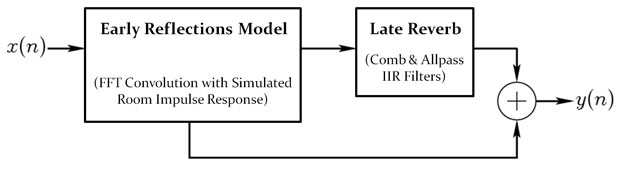
A hybrid algorithmic reverberator was prototyped using Matlab. Reverberation in a real room has two main components: early reflections and late reverberation. Early reflections are perceived within about 100 ms of hearing a direct sound. These reflections give important cues about your location in a room relative to the walls, floor and ceiling. Late reverberation is the ambience you perceive after about 100 ms.
Early reflections can be modeled by finite impulse response (FIR) filtering. Moorer’s reverberator traditionally uses a tap-delay line as the FIR stage. Instead, the hybrid reverberator uses virtual room dimensions to compute early reflections, simulating the impulse response (IR) of a room. The early reflections model is functionally equivalent to an FIR filter. As an input audio signal passes through the first stage of the reverberator it gets filtered (i.e., convolved) with the IR of the virtual room.
The late reverberation model is based on the work of Schroeder. The early reflections are fed into a stage of parallel comb filters, followed by a series of ... [Click to continue]
Spatial Impulse Response Measurement and Reproduction
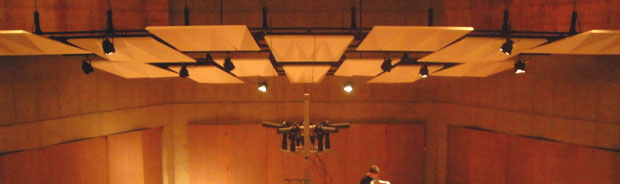
A 5-channel circular microphone array was used to measure a matrix of surround sound room impulse responses. 70 measurements were obtained in the Phillip T. Young Recital Hall: At each of 7 listener locations, the response was captured for 10 sound source positions. This source-listener matrix can be used to simulate the acoustic space from multiple perspectives.
The impulse responses have exceptional signal to noise ratios thanks to the exponential sine sweep measurement technique.
To test the results on listeners, a surround sound convolution reverb was created. By performing multi-sound-source convolutions, dry-recorded signals can be virtually placed into the measured acoustic space. An ensemble with up to 10 performers can be simulated with natural ... [Click to continue]